
Trusted by Global Tech Leaders to Disruptive Startups






Maximize business performance with Agentic AI solutions by
Develop AI agents that autonomously handle complex tasks, reducing manual workload and enabling businesses to focus on strategic initiatives. With minimal oversight required, enterprises achieve higher efficiency, driving higher productivity and operational excellence.
Leverage our agentic AI tool development expertise that identifies patterns and anticipates challenges. By making informed and less error-prone decisions, businesses gain a competitive edge, reduce risks, and ensure smooth operations backed by intelligent automation.
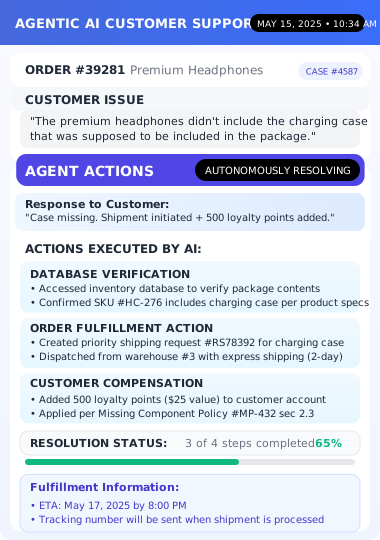
Strengthen customer engagement using agentic AI assistance that personalizes interactions and automates support services. Our agentic AI development company leverages natural language processing and sentiment analysis that resolve queries, recommend tailored solutions, and enhance user satisfaction.
Improve efficiency in human resource management with autonomous AI systems that automate processes like recruitment, employee engagement, and performance tracking.
Integrate agentic AI-powered business automation harmoniously with your current systems through flexible APIs and custom integrations. This eliminates the need for expensive infrastructure overhauls and allows for gradual change across departments.
Unlock operational efficiency with enterprise-grade agentic AI development services








Customer success stories across AI ecosystem

Daffodil develops an AI-powered license plate recognition app for efficient parking lot management
Explore Case Study
Daffodil helps an urban planning firm to leverage AI and detect green space from geo-spatial data.
Explore Case Study
Developing an AI-based smart monitoring and anomaly detection system for oil & gas turbomachinery
Explore Case Study
Developing a machine learning-based surveyor solution for a rapidly growing civil engineering consultancy
Explore Case Study
A Nigeria-based utility billing platform scales its user base and business using data analytics
Explore Case Study
Developing an AI-based image editing solution for one of India’s largest online jewelry marketplaces- eJohri
Explore Case StudyTurn complex operations into autonomous workflows with AI agents
Get in touchAutomate every department with intelligent agentic AI solutions

Customer support
- Autonomous customer support that independently resolves inquiries across multiple channels 24/7
- Independent sentiment analysis agents that monitor customer emotions and adjust interaction strategies
- Escalation management AI agents that determine when human intervention is required
- Self-managing knowledge base agents that continuously update and improve support documentation

IT and technology
- Cybersecurity monitoring to detect threats and implement protective measures
- Self-directed system maintenance to optimize performance and prevent downtime
- User access control that provisions accounts and manages permissions
- Independent IT helpdesk agents to resolve technical issues and guide users through solutions

Quality assurance and control
- Defect detection AI agents that monitor quality
- Self-directed process optimization for workflow analysis and efficiency improvements
- Autonomous testing protocol agents that execute quality validation procedures
- Self-managing documentation agents that maintain quality records and audit trails

Legal and compliance
- Automated contract analysis and compliance verification
- Real-time monitoring for regulatory adherence
- AI-powered risk assessment and mitigation
- Knowledge management with agentic AI capabilities

Procurement and purchasing
- Spend analysis to monitor purchasing patterns and identify cost savings
- Independent market analysis agents that monitor pricing trends and supplier capabilities
- Independent market analysis agents that monitor pricing trends

Supply chain and operations
- Inventory management that independently monitors stock levels and triggers reorders
- Supplier management AI agents that evaluate vendor performance
- Self-managing warehouse optimization to organize layouts
Industries we serve with our agentic AI development services

Healthcare
- Patient appointment scheduling and healthcare workflow management
- Independently analyze medical records and recommend a treatment plan
- Self-directed drug interaction checks and medication management

Retail and eCommerce
- Automatically reorder inventory when stock runs low
- Handle customer service inquiries 24/7
- Creation and updation of product descriptions and marketing content
- Automatically manage promotional campaigns

Financial services
- Loan applications processing and credit decisions based on certain preset criteria
- Handle routine customer account inquiries and transactions
- Independently generate financial reports and regulatory filings

Transportation and logistics
- Handle shipment tracking and customer notifications
- Fleet maintenance scheduling
- Manage shipping documentation and customs paperwork
- Automatically resolve delivery exceptions and reroute packages

Insurance
- Policy applications processing and renewals without underwriter review
- Handle claims intake and initial assessment without claims
- Automatically calculate premiums and policy pricing
- Generate policy documents and coverage explanations

Real estate
- Automatically screen rental applications
- Handle maintenance requests and coordinate repairs
- Create property listings and marketing materials
- Automatically track property expenses and generate financial reports for owners

Education
- Grade assignments and provide feedback
- Handle student enrollment and registration processes
- Independently manage classroom scheduling and resource allocation without coordinator oversight
- Generate progress reports and academic alerts

Media and entertainment
- Create and schedule social media content
- Handle content moderation and community management
- Optimize content distribution timing across platforms
- Manage subscription billing and customer retention

Travel and hospitality
- Handle booking confirmations and modifications
- Room assignments management and upgrades without front desk coordination
- Manage housekeeping schedules and maintenance requests
- Independently handle guest complaints and service recovery
Build industry specific AI agents with us
Get in touchChoose from our flexible engagement models for agentic AI development

Fixed cost model
Perfect for well-defined projects with clear requirements. We deliver agentic AI solutions within an agreed timeline and budget, with no hidden costs. Ideal for businesses with a specific vision and limited flexibility needs.

Time and material model
Offers flexibility for evolving project requirements. Pay only for actual hours worked and resources used. Provides adaptability for scope changes and control over development priorities throughout your AI agent development journey.
Dedicated team model
Gain an extension of your in-house team with agentic AI developers exclusively assigned to your project. Ensures seamless collaboration while maintaining direct management over resources and development pace.
Client experiences that reflect the impact of our technical expertise
Mark Kozak
Co-Founder, MayaMD

Oluwatosin Odunlami
CEO, GoKonnect Interactive Media
““Despite encountering issues with the existing code, they maneuvered well around stumbling blocks and rewarded us with high-quality solutions, which we didn’t get from the previous team we worked with. They met both our deadlines and requirements satisfactorily, accommodating all our team’s change requests throughout the process.””

Nico Roberts
CEO, Rootery
““We’ve been in this market for a while, and they’re by far the most cost-effective. Their team and customer service are top-notch. We’re a startup that changes our mind often, and they’ve been able to adapt quickly.””
James Nieman
Creator and Founder, Sorta Jobs

Manav Bhargava
COO & Co-founder, Mechademy Incorporated
““What impressed us the most was how they understood our business case and translated it into functionalities seamlessly. The team was extremely responsive and went beyond expectations to cater to our extensive set of questions and requirements.””

Alfred Swartzbaugh
Founder & CEO, Match Rider
““They communicate very well, which is rare in development. They understand what I’m saying and implement accordingly—a soft skill that’s critical in remote development.””
Mark Kozak
Co-Founder, MayaMD
Oluwatosin Odunlami
CEO, GoKonnect Interactive Media
““Despite encountering issues with the existing code, they maneuvered well around stumbling blocks and rewarded us with high-quality solutions, which we didn’t get from the previous team we worked with. They met both our deadlines and requirements satisfactorily, accommodating all our team’s change requests throughout the process.””
Nico Roberts
CEO, Rootery
““We’ve been in this market for a while, and they’re by far the most cost-effective. Their team and customer service are top-notch. We’re a startup that changes our mind often, and they’ve been able to adapt quickly.””
James Nieman
Creator and Founder, Sorta Jobs
Manav Bhargava
COO & Co-founder, Mechademy Incorporated
““What impressed us the most was how they understood our business case and translated it into functionalities seamlessly. The team was extremely responsive and went beyond expectations to cater to our extensive set of questions and requirements.””
Alfred Swartzbaugh
Founder & CEO, Match Rider
““They communicate very well, which is rare in development. They understand what I’m saying and implement accordingly—a soft skill that’s critical in remote development.””
Watch our podcast on Agentic AI
Listen to our host Anmol Satija and Jesse Anglen, CEO of Rapid Innovation as they explore how Agentic AI is redefining customer service, streamlining operations, and enhancing decision-making for tech leaders.
Watch now
Why Daffodil Software
Recognized excellence. proven customer satisfaction





25+
Years Of Software Engineering Excellence

150+
Global Clientele

4.8
Avg CSAT Score

95%
Customer Retention Rate

1000+
Software Engineering Experts

50+
Subject Matter Experts
Tools And Technologies We Excel In
Daffodil has been an early adopter of emerging AI technologies and has built extensive experience in various programming languages, frameworks, libraries, and tools. We continuously experiment with new technologies through our in-house R&D labs and pass on the learnings to our clients for a competitive edge.


Crafting intelligent AI agents: the journey from concept to deployment

Purpose and goal definition
- Define agent purpose: Identify autonomous tasks and decision-making scenarios the agent will handle.
- Set agent goals: Establish clear, measurable objectives aligned with business outcomes.
- Map agent boundaries: Determine the extent of autonomy- what decisions the AI agent can make independently.
- Design agent persona: Craft the agent’s identity, tone, behavior, and interaction style (especially for LLM-based agents).
Context mapping
- Set agent environment: Define the physical or digital space in which the agent operates, including data sources, API development and integration, user interfaces, and more.
- Set contextual constraints: Establish operational, ethical, and regulatory constraints.
Agent architecture design
- Select architecture type: Choose between LLM-based, RL-based, symbolic, or hybrid agents.
- Define perception and action layers: Determine how the agent will perceive input and act upon it.
- Design planning and reasoning modules: Architect how the agent makes multi-step decisions or plans actions over time.
- Integrate memory and feedback loops: Decide on short-term and long-term memory mechanisms.
Intelligence training and simulation
- Data preparation: Gather and preprocess data (structured, unstructured, domain-specific).
- Train core models: Use supervised, unsupervised, reinforcement learning, or fine-tuning on foundational models.
- Simulate agent scenarios: Run the agent through real-world or synthetic tasks to refine behaviors.
Integration and interfacing
- Connect to existing systems: Ensure seamless integration with enterprise software, APIs, and user interfaces.
- Enable multi-modal inputs: Allow the agent to work with text, voice, vision, or sensor data as needed.
- Ensure fail-safes: Implement human-in-the-loop mechanisms for critical interventions.
Deployment
- Deploy to production: Launch the agent in the target environment-cloud, edge, or on-prem.
- Enable self-optimization: Implement mechanisms like RLHF (Reinforcement Learning with Human Feedback) or online learning.
- Monitor behavior and KPIs: Use analytics dashboards to track agent performance and anomalies.
Ongoing support
- Feature expansion: Add new capabilities as business needs grow.
- Cross-agent collaboration: Enable multi-agent systems for complex workflows.
- Ongoing support and maintenance: Get end-to-end support for your AI agent.
(item.title)+×
(item.content) && (- Define agent purpose: Identify autonomous tasks and decision-making scenarios the agent will handle.
- Set agent goals: Establish clear, measurable objectives aligned with business outcomes.
- Map agent boundaries: Determine the extent of autonomy- what decisions the AI agent can make independently.
- Design agent persona: Craft the agent’s identity, tone, behavior, and interaction style (especially for LLM-based agents).
(item.title)+×
(item.content) && (- Set agent environment: Define the physical or digital space in which the agent operates, including data sources, API development and integration, user interfaces, and more.
- Set contextual constraints: Establish operational, ethical, and regulatory constraints.
(item.title)+×
(item.content) && (- Select architecture type: Choose between LLM-based, RL-based, symbolic, or hybrid agents.
- Define perception and action layers: Determine how the agent will perceive input and act upon it.
- Design planning and reasoning modules: Architect how the agent makes multi-step decisions or plans actions over time.
- Integrate memory and feedback loops: Decide on short-term and long-term memory mechanisms.
(item.title)+×
(item.content) && (- Data preparation: Gather and preprocess data (structured, unstructured, domain-specific).
- Train core models: Use supervised, unsupervised, reinforcement learning, or fine-tuning on foundational models.
- Simulate agent scenarios: Run the agent through real-world or synthetic tasks to refine behaviors.
(item.title)+×
(item.content) && (- Connect to existing systems: Ensure seamless integration with enterprise software, APIs, and user interfaces.
- Enable multi-modal inputs: Allow the agent to work with text, voice, vision, or sensor data as needed.
- Ensure fail-safes: Implement human-in-the-loop mechanisms for critical interventions.
(item.title)+×
(item.content) && (- Deploy to production: Launch the agent in the target environment-cloud, edge, or on-prem.
- Enable self-optimization: Implement mechanisms like RLHF (Reinforcement Learning with Human Feedback) or online learning.
- Monitor behavior and KPIs: Use analytics dashboards to track agent performance and anomalies.
(item.title)+×
(item.content) && (- Feature expansion: Add new capabilities as business needs grow.
- Cross-agent collaboration: Enable multi-agent systems for complex workflows.
- Ongoing support and maintenance: Get end-to-end support for your AI agent.
Purpose and goal definition
- Define agent purpose: Identify autonomous tasks and decision-making scenarios the agent will handle.
- Set agent goals: Establish clear, measurable objectives aligned with business outcomes.
- Map agent boundaries: Determine the extent of autonomy- what decisions the AI agent can make independently.
- Design agent persona: Craft the agent’s identity, tone, behavior, and interaction style (especially for LLM-based agents).
Context mapping
- Set agent environment: Define the physical or digital space in which the agent operates, including data sources, API development and integration, user interfaces, and more.
- Set contextual constraints: Establish operational, ethical, and regulatory constraints.
Agent architecture design
- Select architecture type: Choose between LLM-based, RL-based, symbolic, or hybrid agents.
- Define perception and action layers: Determine how the agent will perceive input and act upon it.
- Design planning and reasoning modules: Architect how the agent makes multi-step decisions or plans actions over time.
- Integrate memory and feedback loops: Decide on short-term and long-term memory mechanisms.
Intelligence training and simulation
- Data preparation: Gather and preprocess data (structured, unstructured, domain-specific).
- Train core models: Use supervised, unsupervised, reinforcement learning, or fine-tuning on foundational models.
- Simulate agent scenarios: Run the agent through real-world or synthetic tasks to refine behaviors.
Integration and interfacing
- Connect to existing systems: Ensure seamless integration with enterprise software, APIs, and user interfaces.
- Enable multi-modal inputs: Allow the agent to work with text, voice, vision, or sensor data as needed.
- Ensure fail-safes: Implement human-in-the-loop mechanisms for critical interventions.
Deployment
- Deploy to production: Launch the agent in the target environment-cloud, edge, or on-prem.
- Enable self-optimization: Implement mechanisms like RLHF (Reinforcement Learning with Human Feedback) or online learning.
- Monitor behavior and KPIs: Use analytics dashboards to track agent performance and anomalies.
Ongoing support
- Feature expansion: Add new capabilities as business needs grow.
- Cross-agent collaboration: Enable multi-agent systems for complex workflows.
- Ongoing support and maintenance: Get end-to-end support for your AI agent.
Empower your business with intelligent agentic AI solutions. Let's connect today

Frequently asked questions (FAQs)
Traditional AI responds to specific commands and questions. On the other hand, Agentic AI is much more independent. It can identify what needs to be done, create plans, adapt when things change, and use various tools to reach goals. It’s like having a digital employee rather than just a smart calculator or search engine.
Creating AI agents involves designing how they’ll think and work, connecting them to the right AI models, adding tools they can use, building in safety measures, and testing everything thoroughly. The process requires expertise in AI technology, software development, and understanding your specific business needs and workflows.
Less advanced agentic AI solutions cost $25,000-$100,000. More advanced systems with custom features and multiple business system connections range from $150,000-$500,000+. Ongoing costs for maintenance and improvements usually add 20-30% yearly.
Basic agentic AI solutions take about 2-3 months to build. Mid-level systems that connect to several of your business tools need 4-6 months. Complex enterprise solutions with advanced capabilities and extensive connections to your existing systems typically require 6-12 months from planning to full deployment.
Your business can connect AI assistants to existing systems through direct API links, custom web dashboards, workflow automation tools, or extensions to your current software. We’ll recommend the best approach based on your existing technology, security needs, how employees will use it, and which business processes need improvement.
Common challenges include ensuring reliable performance across different situations, connecting to all necessary business systems, addressing security concerns, creating proper oversight rules, getting employee buy-in, providing adequate training, handling unusual cases effectively, and maintaining the right balance between AI independence and human control.
Successful AI assistants need regular updates to add new capabilities, performance monitoring, expansion to handle new tasks, fine-tuning to maintain effectiveness, security updates, user training, and periodic reviews to keep everything running smoothly. Ongoing support ensures your AI systems continue to deliver value as your business needs change.